Why Are My Hands Shaking? A Neurologist Explains Tremors
By Dr. Ritwiz Bihari
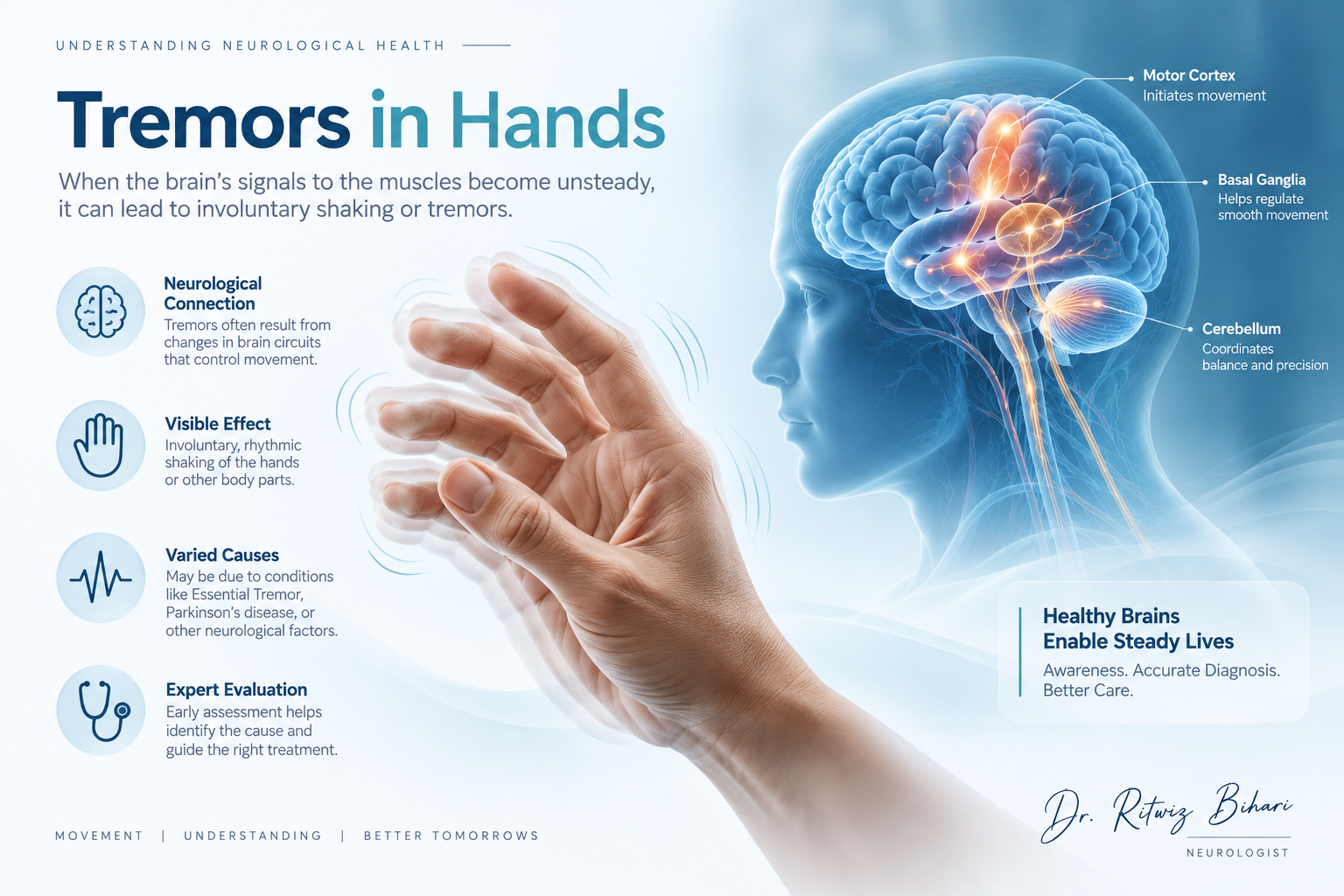
- Not all hand tremors signal Parkinson's disease. Essential Tremor — the most common movement disorder in adults — causes rhythmic shaking that worsens with action (like holding a cup), while Parkinson's tremor characteristically occurs at rest.
- Key red flags that warrant urgent neurological evaluation include tremors that worsen progressively over months, are accompanied by stiffness or slowness of movement, or begin to interfere with daily tasks like eating, writing, or buttoning clothes.
- Both conditions are highly treatable. An early, accurate diagnosis by a movement disorder specialist is the single most important step toward regaining quality of life.
Introduction: The Question I Hear Every Day
Barely a week goes by in my neurology clinic in Lucknow without a worried patient — or more often, a worried son or daughter — sitting across from me and saying: "Doctor, my father's hands have been shaking for a few months now. Is it Parkinson's?"
The fear is completely understandable. Shaking hands, medically known as a tremor, can be alarming to witness. But I want to give you a piece of reassurance right at the start: not all tremors are Parkinson's disease, and the most common cause of shaking hands in adults is a separate, much more benign condition called Essential Tremor. Understanding the difference can save you months of unnecessary worry — and help you get the right treatment faster.
What Exactly Is a Tremor?
A tremor is an involuntary, rhythmic muscle contraction that causes a body part — most commonly the hands — to shake. It is not a disease itself, but a symptom of an underlying neurological condition. Crucially, the type of tremor — when it occurs, what makes it better or worse — is the most important clue a neurologist uses to reach the correct diagnosis.
The Two Most Common Causes: Essential Tremor vs. Parkinson's Disease
1. Essential Tremor (ET) — The Most Common Tremor
Essential Tremor affects roughly 1 in 25 adults over the age of 40 in India. It is often misdiagnosed as Parkinson's disease, which leads to unnecessary alarm. The defining characteristic of Essential Tremor is that it is an action tremor — it appears when the person is actively using their hands.
- When it appears: While holding objects (a cup of tea, a phone), writing, eating, or reaching for something.
- When it disappears: At rest. If your parent sits with their hands in their lap, the shaking largely stops.
- Common family history: Essential Tremor frequently runs in families. If a parent or grandparent had it, the risk is significantly higher.
- Head and voice involvement: ET can also cause the head to shake in a "yes-yes" or "no-no" motion, or give the voice a tremulous quality.
- Alcohol test: Many patients notice (and sometimes self-medicate with) a glass of alcohol, as it temporarily suppresses Essential Tremor. This is a useful diagnostic clue, though not a treatment recommendation.
2. Parkinson's Disease — The Tremor at Rest
Parkinson's disease is a progressive neurological condition caused by the degeneration of dopamine-producing neurons in the brain. The tremor of Parkinson's has a very different character:
- When it appears: At rest — when the hands are relaxed and not being used, such as when sitting or walking.
- When it reduces: Paradoxically, it often diminishes or temporarily disappears when the person reaches out to grab something.
- Classic appearance: The Parkinson's tremor is often described as a "pill-rolling" motion — the thumb and index finger rub against each other as if rolling a small tablet.
- Accompanying symptoms: This is the most critical point. Parkinson's tremor does not come alone. It is accompanied by the other cardinal features of Parkinson's: slowness of movement (bradykinesia), muscle stiffness (rigidity), and problems with balance. If the shaking is the only symptom, Parkinson's is less likely.
Other Causes of Tremors I Evaluate in My Clinic
Essential Tremor and Parkinson's are the most common causes, but my evaluation also considers:
- Physiological Tremor: Everyone has a very fine, barely perceptible tremor. This can be exaggerated by anxiety, caffeine, thyroid disorders (hyperthyroidism), or certain medications like inhalers or steroids.
- Medication-Induced Tremor: Several commonly prescribed medications — including some psychiatric drugs, anti-nausea medications, and certain heart medications — can cause or worsen tremors.
- Wilson's Disease: A rare but treatable genetic condition where copper accumulates in the body. It is critically important to rule out in younger patients (under 40) presenting with tremors.
- Cerebellar Tremor: Damage to the cerebellum (the back part of the brain) causes an "intention tremor" that worsens as the hand approaches its target, like a finger touching the nose.
When Should You See a Neurologist Immediately?
In my practice, I advise patients to seek a neurological consultation without delay if any of the following are present:
- Tremors that began recently and are getting progressively worse over weeks or months.
- Shaking that is accompanied by slowness in daily movements — getting up from a chair, walking, or turning in bed.
- A change in handwriting — specifically, writing becoming smaller and more cramped (a sign called micrographia, strongly associated with Parkinson's).
- The tremor is causing significant disability — difficulty eating independently, inability to hold a glass, or problems with work.
- Tremors in someone under 40 years of age, which requires more urgent investigation to rule out conditions like Wilson's disease.
- Any tremor accompanied by confusion, memory loss, or a sudden onset.
How We Diagnose and Treat Tremors
There is no single blood test or scan that diagnoses Essential Tremor or Parkinson's. The diagnosis is fundamentally clinical — based on a detailed history and a careful neurological examination. I will observe the character of the tremor, test for muscle tone, assess your gait, and check reflexes. In some cases, I will order an MRI, thyroid function tests, or specific blood tests to rule out secondary causes.
The important message is that both conditions are highly treatable. Essential Tremor responds well to medications like beta-blockers or primidone. Parkinson's disease, while progressive, can be managed effectively for many years with a tailored combination of medications, physiotherapy, and in selected cases, surgical options like Deep Brain Stimulation (DBS). An early, accurate diagnosis is the foundation of everything.
Living Well With Tremors: Practical Daily Strategies
While we work on diagnosing and treating the underlying cause, patients often ask what they can do immediately to cope. Here are practical strategies I recommend:
- Weighted Utensils: Specially designed weighted cups and cutlery can dramatically reduce the visible shake during meals, restoring independence and dignity at the dining table.
- Adaptive Writing Tools: Weighted pens and pen grips can improve handwriting for Essential Tremor patients who need to write regularly.
- Lifestyle Adjustments: Reducing caffeine (a known tremor aggravator), ensuring consistent sleep, and managing stress all reduce the amplitude of tremors, particularly Essential Tremor.
- Physiotherapy: A physiotherapist specialised in neurological conditions can teach exercises that improve compensation and reduce functional impact. I frequently refer my patients to movement disorder care programs that include physiotherapy as a core component.
For patients with Parkinson's disease, maintaining physical activity is one of the most important non-pharmacological interventions. Research consistently shows that regular aerobic exercise and physiotherapy slow the functional decline of Parkinson's disease significantly.
Conclusion
If you or a loved one has noticed new or worsening hand tremors, please do not delay seeking a specialist opinion. The distinction between a benign, manageable tremor and something that requires a specific treatment protocol can only be made with a proper neurological assessment. Early diagnosis and early treatment consistently lead to the best quality of life outcomes. You can book a consultation at my clinic — we are here to give you answers, not just reassurance.