Stroke Warning Signs: Use BE-FAST and Act Within 60...
By Dr. Ritwiz Bihari
- Stroke is the second leading cause of death and the leading cause of disability in India. It is a medical emergency — for every minute a large-vessel stroke goes untreated, approximately 1.9 million neurons die. Speed of action is the single most important factor determining outcome.
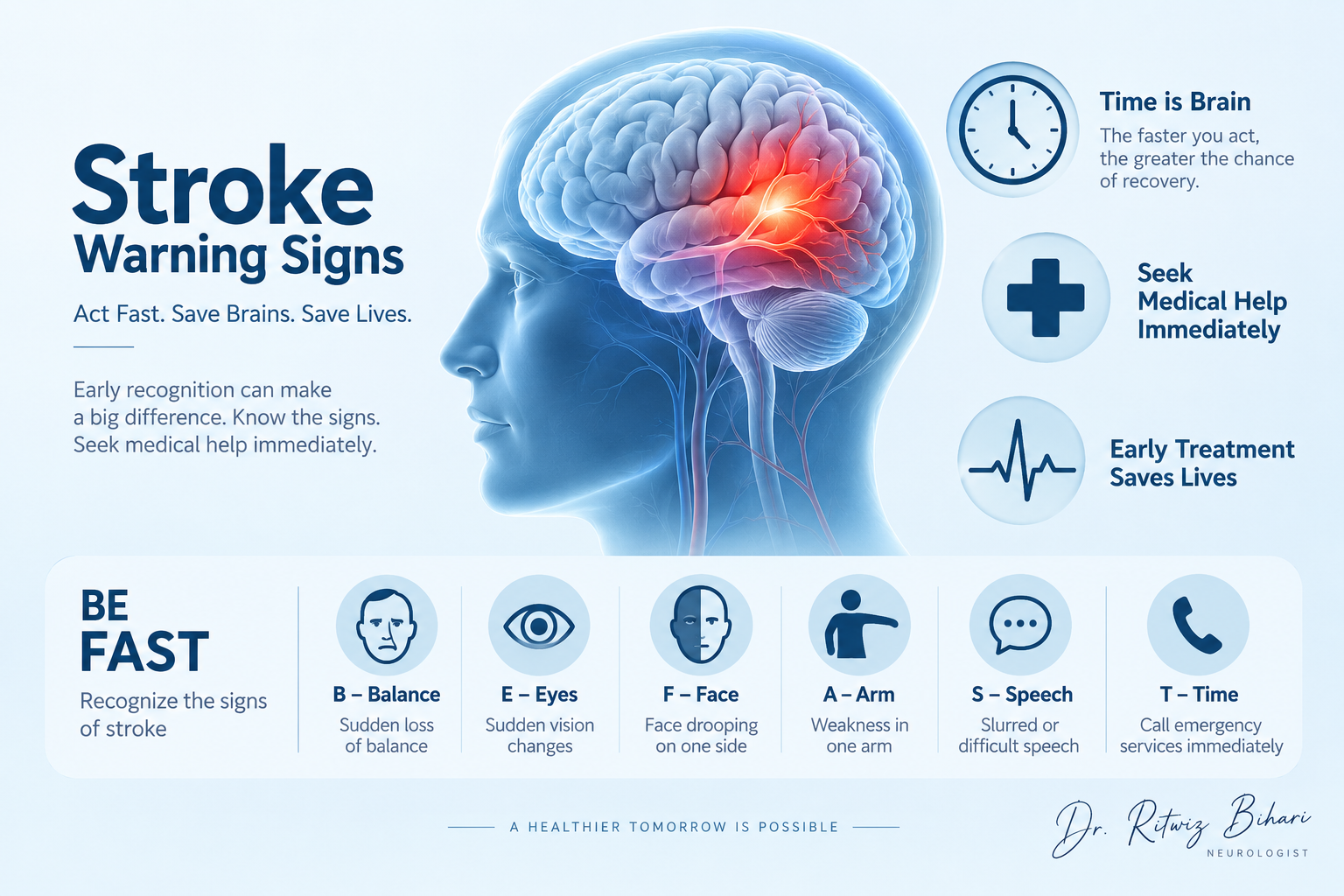
- The BE-FAST acronym (Balance, Eyes, Face, Arms, Speech, Time) is the most comprehensive tool for recognising stroke symptoms. Any sudden onset of these symptoms — even if they seem to resolve — demands an emergency call and immediate hospital transfer.
- The clot-dissolving treatment (IV thrombolysis with tPA) is highly effective but has a strict 4.5-hour treatment window from symptom onset. A mechanical thrombectomy can be performed up to 24 hours in selected cases. This is why calling emergency services the moment you recognise symptoms is non-negotiable.
Introduction: The Emergency That Waits for No One
In my years of practice as a neurologist in Lucknow, the cases that stay with me longest are not the complex diagnoses or the rare conditions — they are the stroke patients who arrived too late. Patients whose families waited, hoping the symptoms would pass on their own. Patients who reached the hospital 6, 8, or 12 hours after the stroke began, their window for effective treatment long closed.
And then there are the patients who arrived within 90 minutes — who received timely treatment and walked out of the hospital. I have seen both realities, and I can tell you with complete certainty: the difference between those two outcomes is almost always the speed at which the family recognised the warning signs and acted.
This blog exists to close that gap.
What Is a Stroke?
A stroke occurs when blood supply to a part of the brain is suddenly cut off. There are two main types:
- Ischaemic Stroke (80–85% of cases): A blood clot blocks an artery supplying the brain. This is the type amenable to clot-dissolving therapy.
- Haemorrhagic Stroke (15–20% of cases): A blood vessel in the brain ruptures, causing bleeding into or around the brain. This requires different, urgent management.
Regardless of type, the result is the same: brain cells deprived of oxygen begin to die within minutes. For a large-vessel ischaemic stroke, the brain loses approximately 1.9 million neurons every single minute without treatment. This is the biological reality that gives rise to the now widely-accepted principle: Time is Brain. If you or a family member have been diagnosed with high blood pressure, atrial fibrillation, or diabetes, I strongly encourage you to read about our stroke prevention and management programme — proactive care saves lives before a stroke ever happens.
Recognise Stroke: The BE-FAST Acronym
The medical community recently updated the classic FAST acronym to BE-FAST, adding two critical symptoms that the older version missed — and which account for a significant proportion of strokes that are delayed or missed in emergency settings. Please memorise this:
B — Balance: Sudden Loss of Balance or Coordination
A sudden inability to walk, severe dizziness, or a loss of coordination — particularly when it comes on abruptly without warning — is a major stroke warning sign. This reflects a stroke affecting the cerebellum or the brainstem. Many patients describe feeling as though they are suddenly "drunk" or that the floor is tilting beneath them. This symptom alone, if sudden and severe, warrants an emergency call.
E — Eyes: Sudden Vision Changes
Sudden blurring of vision in one or both eyes, sudden complete loss of vision in one eye (often described as a "curtain coming down"), or seeing double (diplopia) are all classic stroke symptoms that are frequently missed or misattributed to eye strain. A stroke affecting the visual cortex at the back of the brain can cause sudden blindness in half of your visual field — often described as only half of each scene being visible.
F — Face: Facial Drooping
Ask the person to smile. Does one side of the face droop or appear uneven? Facial weakness — one corner of the mouth pulling down, an eyelid that won't fully open, or numbness on one side of the face — is one of the most recognisable signs of stroke. This is caused by disruption to the brain's motor circuits that control facial muscles.
A — Arms: Arm Weakness
Ask the person to raise both arms straight out in front of them with palms facing up, and hold them there for 10 seconds. If one arm drifts downward, or cannot be raised at all, this is a strong positive sign. Sudden weakness or numbness in one arm — or one leg — that appears without any physical cause is a hallmark of stroke.
S — Speech: Slurred or Confused Speech
Ask the person to repeat a simple sentence: "The sky is blue." Is their speech slurred? Are they struggling to find words? Are they saying words that don't make sense? Or do they seem to understand what you're saying but cannot form a coherent reply? All of these patterns reflect different types of language disruption (aphasia) caused by a stroke in the dominant hemisphere of the brain.
T — Time: Time to Call Emergency Services Immediately
If any of the above symptoms are present — even mildly, even if they seem to be getting better — call 112 immediately. Do not drive the patient yourself unless there is absolutely no other option. Do not wait to see if the symptoms improve. Do not give the patient food, water, or medication. Call emergency services, note the exact time symptoms began, and head to the nearest hospital with a stroke unit.
The Critical Treatment Window: Why Every Minute Matters
The primary treatment for an ischaemic stroke is IV thrombolysis — an intravenous injection of a clot-dissolving drug called tPA (tissue Plasminogen Activator). This drug can dissolve the clot and restore blood flow to the affected brain tissue, dramatically reversing stroke deficits. However, it has a strict eligibility window: it must be administered within 4.5 hours of symptom onset.
For larger vessel occlusions, a procedure called mechanical thrombectomy — where a catheter is used to physically retrieve the clot from inside the brain's artery — can be performed in selected patients up to 24 hours from symptom onset at specialised centres.
The practical implication of these time windows is stark: a patient who calls emergency services within 30 minutes of symptom onset has a very high chance of receiving treatment and making a good recovery. A patient who arrives at the hospital 5 hours later may have missed the thrombolysis window entirely. This is why recognition — by the family, by bystanders — is so critical.
A Special Warning: The Transient Ischaemic Attack (TIA)
A TIA, sometimes called a "mini-stroke," produces identical BE-FAST symptoms but resolves completely within minutes to hours, leaving no permanent deficit. Patients and families frequently reassure themselves that because the symptoms "went away on their own," there is no need to rush to hospital. This is one of the most dangerous misconceptions I encounter.
A TIA is a medical emergency. It is a warning that a full, disabling stroke may be imminent — the risk of a major stroke within 48 hours of a TIA is between 5 and 10%. A TIA patient needs urgent hospital evaluation, investigation, and initiation of protective treatment. A resolved TIA is not a relief — it is an urgent alarm.
Risk Factors You Can Control
The most powerful risk factors for stroke — uncontrolled hypertension, uncontrolled diabetes, atrial fibrillation, smoking, and obesity — are all modifiable. If you have been diagnosed with high blood pressure, I cannot stress this strongly enough: take your medication consistently, monitor your pressure at home, and attend regular follow-ups. Uncontrolled hypertension is the single largest preventable cause of stroke in India.
Conclusion
Stroke is the emergency where public awareness directly saves lives. The medicine works — we have highly effective tools to reverse a stroke when patients arrive in time. But those tools are useless if the family doesn't recognise what is happening. Share this information with your parents, your siblings, and your neighbours. Know BE-FAST. Call 112 immediately if you see these signs. And if you or a family member have risk factors for stroke, book a preventive neurology consultation — proactive management of your vascular risk factors is the most powerful stroke prevention strategy there is.