Your Child Had a Seizure: What Every Parent Needs to Know
By Dr. Ritwiz Bihari
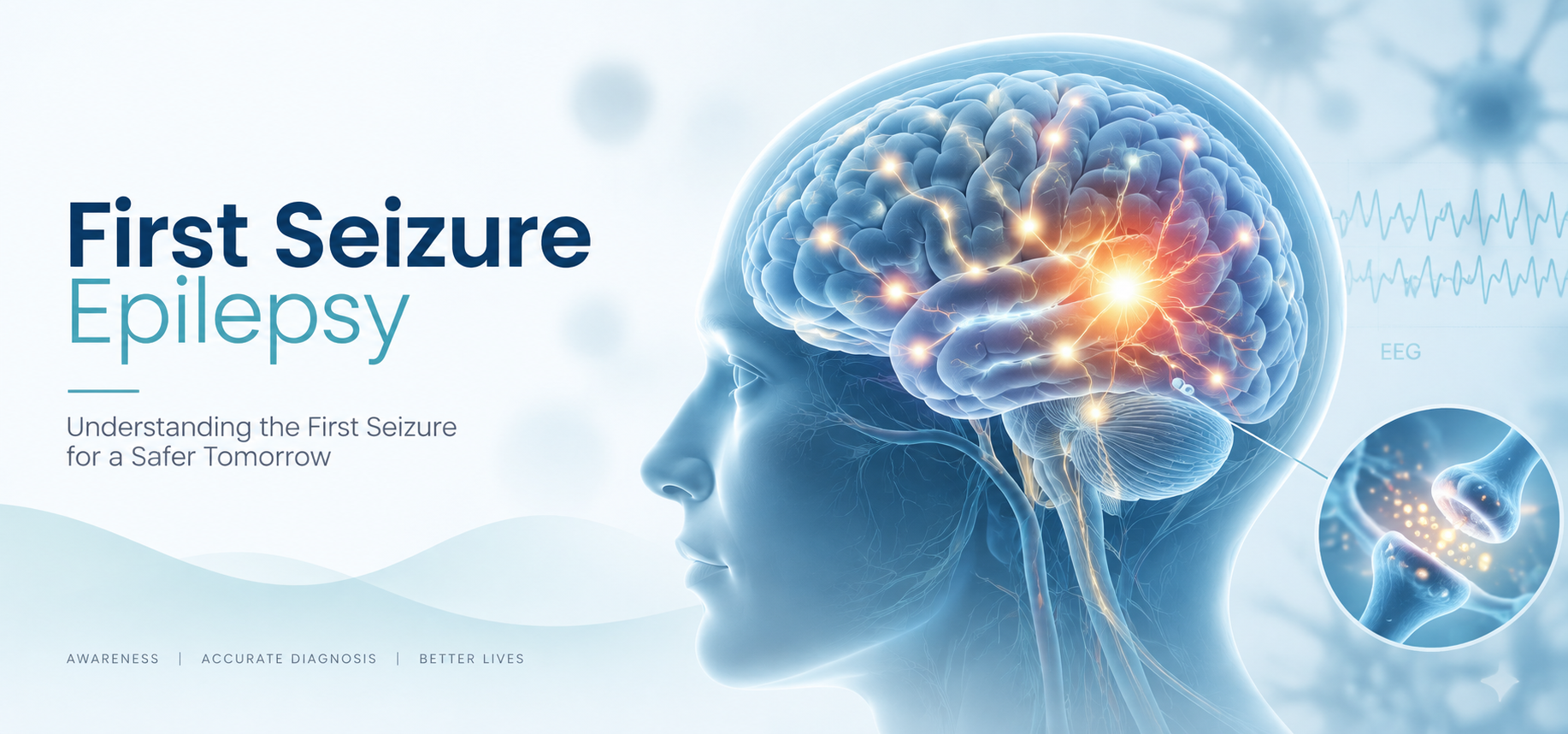
- A single seizure does not automatically mean a child has epilepsy. Epilepsy is formally diagnosed only after two or more unprovoked seizures. The cause — fever, infection, metabolic imbalance, or idiopathic — critically determines the management plan.
- During a seizure: protect from injury, place on their side, time the seizure, do NOT put anything in their mouth, and call 112 if it lasts more than 5 minutes.
- Every child who has a first seizure must be evaluated by a neurologist. The assessment includes a detailed history, EEG, MRI, and blood tests to determine cause, recurrence risk, and whether medication is needed.
To Every Parent Reading This
If you have arrived at this page because your child just had a seizure, I want to first acknowledge something: what you witnessed was frightening in a way that is difficult to put into words. The sudden loss of consciousness, the stiffening, the rhythmic jerking — it is designed by every human instinct to trigger absolute alarm. You did the right thing by seeking information.
As a neurologist who has evaluated hundreds of children and adults after a first seizure, I want to give you the clear, structured guidance that I give to every anxious family in my clinic. If your child has been referred by another doctor, you can also read more about what our epilepsy evaluation service involves. Let me walk you through what you need to know.
First: What to Do During a Seizure — Immediate First Aid
When a seizure is actively happening, most parents instinctively want to hold the child down or put something in their mouth. Please do not do either. Here is exactly what to do:
- Stay calm and stay with the child. Your presence and calmness are the most important things you can offer.
- Time the seizure from the moment it begins. This is critically important information for the doctor. Use the stopwatch on your phone the moment it starts.
- Protect from injury. Gently lower the child to the floor if they are not already there. Move any sharp or hard objects away. Cushion their head with something soft.
- Turn them onto their side (Recovery Position). This prevents them from choking on saliva or vomit. Keep their airway clear.
- Do NOT put anything in their mouth. This is a dangerous myth. A person cannot swallow their tongue during a seizure. Putting a finger, spoon, or cloth in their mouth can break teeth, injure your hand, or obstruct their airway.
- Do NOT restrain or hold them down forcefully. Gentle guidance to prevent injury is appropriate; forceful restraint is not.
- Call 112 immediately if: The seizure lasts more than 5 minutes, the child does not regain normal consciousness, the child has difficulty breathing, or if this is the first seizure ever.
After the Seizure: The Post-Ictal Phase
After the active shaking stops, your child will likely be deeply confused, exhausted, and possibly inconsolable or unresponsive for a period ranging from a few minutes to an hour. This is called the post-ictal phase — a normal part of the brain's recovery after a seizure, not a continuation of it. Keep the child in the recovery position, speak calmly to them, and do not give food or water until they are fully awake and aware.
It is also important to note that some children may sleep deeply after a seizure. This is normal. Do not try to keep them awake. However, if the child cannot be roused at all or their breathing is laboured, call emergency services.
Does One Seizure Mean My Child Has Epilepsy?
This is the question I hear most urgently from every parent. The honest, medically accurate answer is: not necessarily. Here is what the evidence tells us:
- Epilepsy is defined as two or more unprovoked seizures occurring more than 24 hours apart. A single seizure, by definition, is not epilepsy.
- After a first unprovoked seizure, the risk of a second seizure within 2 years is approximately 40–50%. Roughly half of children who have a single seizure will never have another one.
- After a second unprovoked seizure, the risk of recurrence rises to over 80%, and this is when we formally diagnose epilepsy and typically begin medication.
Provoked vs. Unprovoked Seizures
A critical distinction I always make is between a provoked and an unprovoked seizure:
- A provoked seizure has a clear, identifiable trigger — high fever (febrile seizure, the most common seizure type in children aged 6 months to 5 years), brain infection like meningitis or encephalitis, severe electrolyte imbalance, or low blood sugar. Treating the underlying cause is the priority.
- An unprovoked seizure occurs without a clear immediate cause and requires more thorough investigation.
What Tests Will the Neurologist Order?
Every child who has a first seizure must be seen by a neurologist. When you come to my clinic, the evaluation will typically include:
- Detailed History: The description of the seizure from witnesses is invaluable. Video on a phone is extraordinarily helpful — even a few seconds. I will also ask about birth history, developmental milestones, family history of seizures, and any recent illness or fever.
- EEG (Electroencephalogram): A painless test that records the electrical activity of the brain. It identifies abnormal discharge patterns that help classify the seizure type and guide treatment. A normal EEG does not rule out epilepsy, and an abnormal EEG does not automatically confirm it.
- MRI Brain: In most first-seizure evaluations, I recommend an MRI to rule out structural causes — such as a lesion, a birth defect, or a scar from an old injury.
- Blood Tests: To check blood sugar, electrolytes, calcium, liver and kidney function, and other metabolic parameters that can provoke seizures.
Will My Child Need Medication?
This is a nuanced decision that I make individually, in conversation with each family. Factors I consider include the type of seizure, the EEG findings, MRI results, the child's age, and the risk of recurrence. Many children with a single, normal investigation seizure do not require medication at all.
However, when medication is indicated, modern anti-seizure drugs are highly effective and generally well-tolerated in children. The goal is always complete seizure freedom with minimal side effects, allowing the child to attend school, participate in sports, and live a normal, active life. Most children with well-controlled epilepsy lead entirely normal lives.
Safety at Home and School: Practical Guidance for Parents
While your child is under evaluation or on treatment, there are several safety precautions that reduce risk in daily life:
- Bathing: Showers are safer than baths. If a bath is preferred, the water level should be shallow and a parent should always be present or within earshot.
- Swimming: Swimming is generally safe with close supervision. Inform the lifeguard. Your child should never swim alone.
- Heights: Avoid unsupervised climbing or being near open windows on high floors until seizure control is established.
- School: Inform the school nurse and teachers about the seizure history, and share a copy of our seizure action plan. Schools in India are generally supportive and most children need no special academic accommodation.
Conclusion
A first seizure in a child is a medical event that demands prompt, expert evaluation — but it is not an automatic catastrophe. With the right assessment, the vast majority of children with seizures go on to live completely normal, active lives. If your child has had a seizure and has not yet been evaluated by a neurologist, I encourage you to book an appointment at my clinic at the earliest opportunity. Early clarity is the greatest gift you can give your child and yourself.