Bell's Palsy vs. Stroke: A Neurologist Explains the...
By Dr. Ritwiz Bihari
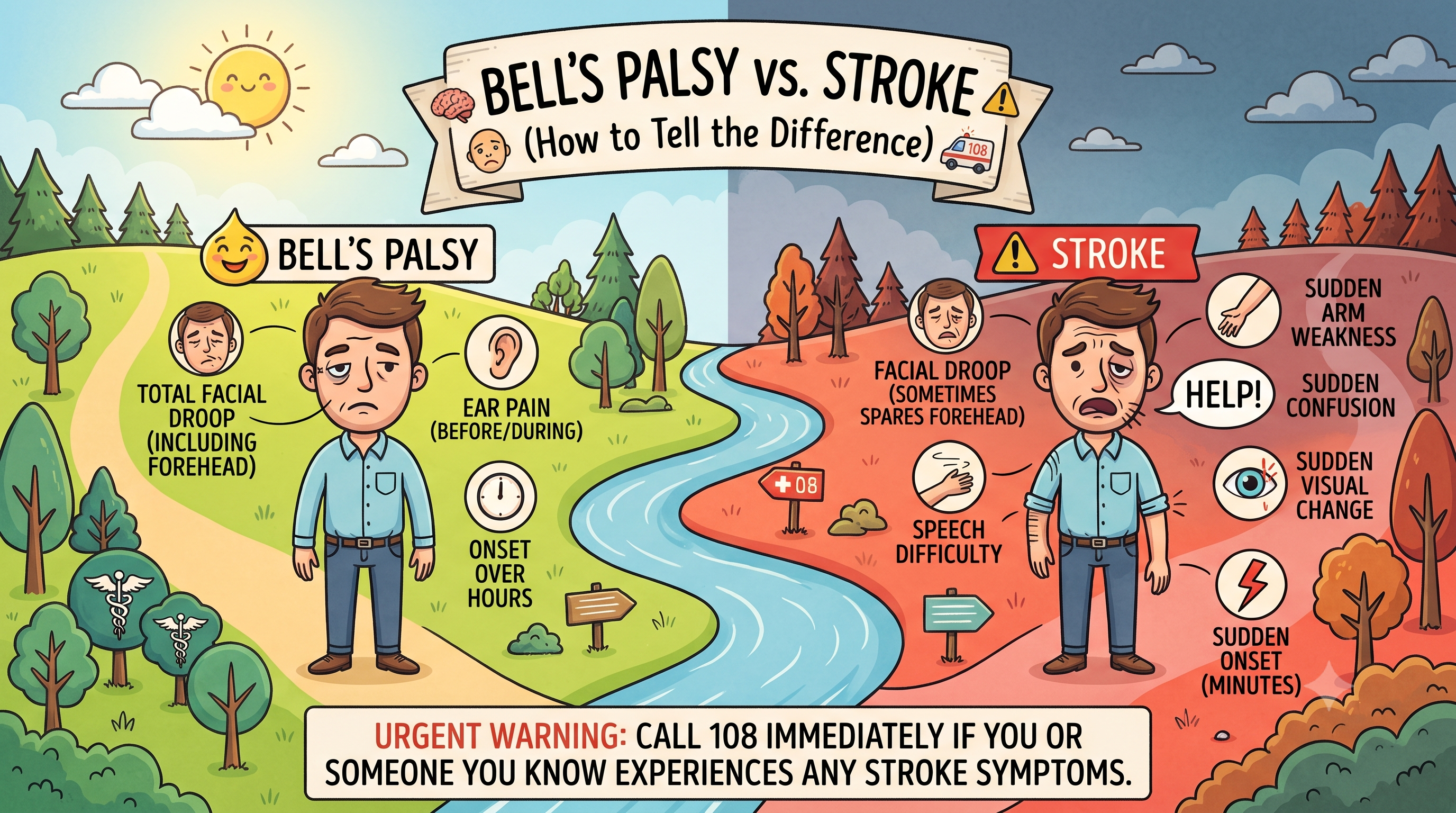
- Bell's Palsy is a peripheral nerve issue that typically paralyzes the entire half of the face (including the forehead), whereas a stroke is a central brain injury that usually spares the forehead.
- A stroke is a life-threatening medical emergency often accompanied by weakness on one side of the body, speech difficulty, or vision changes (the F.A.S.T signs).
- Regardless of your suspicions, sudden facial drooping requires immediate emergency medical evaluation, as time-sensitive stroke treatments (like tPA) must be administered within hours.
Imagine looking in the mirror one morning and realizing that one side of your face is completely unresponsive. Your smile is crooked, your eye won't blink, and water spills from the corner of your mouth. For almost everyone who experiences this, the immediate, terrifying thought is: "Am I having a stroke?"
As a neurologist who specializes in stroke and cerebrovascular diseases, this is one of the most common and urgent scenarios I encounter in the emergency room. Sudden facial paralysis is a high-stakes symptom. It could indeed be a stroke—a life-threatening brain attack where every minute counts. However, it could also be Bell's Palsy, a localized, temporary nerve inflammation that, while distressing, is not dangerous.
Knowing the difference is not just an academic exercise; it dictates the speed and type of medical response required. Here is exactly how neurologists distinguish between the two.
Understanding the Anatomy: Central vs. Peripheral
To understand the difference in symptoms, you must understand the "wiring" of the face.
- A Stroke (Central Issue): A stroke occurs deep inside the brain when a blood vessel is blocked (ischemic) or bursts (hemorrhagic). The damage happens to the upper motor neurons—the brain cells that send the initial command to move your face.
- Bell's Palsy (Peripheral Issue): Bell's Palsy happens outside the brain. It affects the Facial Nerve (Cranial Nerve VII), which is the actual "wire" traveling from the brainstem to the muscles of your face. The nerve becomes inflamed, usually due to a viral infection (like the herpes simplex virus), and swells as it passes through a narrow bony canal in the skull, cutting off its own signals.
The Golden Clue: Look at the Forehead
When a patient arrives with facial drooping, the very first thing I ask them to do is: "Raise your eyebrows and wrinkle your forehead." This simple action is the most critical clinical clue.
Why the Forehead Matters
Mother Nature designed our brains with a fail-safe mechanism. The lower half of your face receives nerve signals from only one side of your brain (the opposite side). However, the upper half of your face (your forehead) receives signals from both sides of your brain.
- In a Stroke: If a stroke damages the right side of the brain, the lower left side of the face will droop. But because the left forehead also gets "backup" signals from the healthy left side of the brain, the forehead is usually spared. A stroke patient can typically still wrinkle their forehead symmetrically.
- In Bell's Palsy: Because the damage is to the main nerve "cable" after it has left the brain, all signals to that side of the face are cut off. The entire half of the face is paralyzed. A patient with Bell's Palsy will have a smooth, unwrinkled forehead on the affected side and will be unable to raise that eyebrow.
Beyond the Face: Stroke Symptoms (The F.A.S.T. Signs)
Bell's Palsy strictly affects the Cranial Nerve VII. A stroke, however, usually damages larger areas of the brain, affecting other bodily functions. If the facial drooping is accompanied by any of the following, it is highly indicative of a stroke:
- Arm or Leg Weakness: Hemiparesis (weakness or paralysis on one side of the body) is a hallmark of a stroke. If you cannot raise both arms equally, call for help immediately.
- Speech Difficulties: Slurred speech (dysarthria) or a sudden inability to find the right words or understand language (aphasia).
- Vision Changes: Sudden blindness in one eye, double vision, or a loss of a specific field of vision.
- Balance and Coordination: Sudden, severe dizziness, inability to walk straight (ataxia), or a sudden, worst-of-your-life headache.
The Hidden Symptoms of Bell's Palsy
While Bell's Palsy doesn't cause arm weakness or slurred speech, it does have its own unique, lesser-known symptoms related to the specific functions of the Facial Nerve:
- Hyperacusis: Sounds may seem abnormally loud on the affected side. (The facial nerve controls a tiny muscle in the ear that dampens loud noises).
- Loss of Taste: Food may taste bland or metallic, as the facial nerve supplies taste to the front two-thirds of the tongue.
- Eye Issues: The inability to blink or close the eye completely leads to severe dryness and tearing on the affected side.
- Pain: A deep aching pain behind the ear or around the jaw often precedes the facial drooping by a day or two.
Diagnosis in the Emergency Room
If you present to the ER with facial drooping, the medical team will act fast. The primary goal is to rule out a stroke. We will perform a rapid neurological exam. If a stroke is suspected, you will immediately undergo a CT Scan of the brain. This is crucial to check for bleeding before any blood-thinning medications can be given. We may also order an MRI or an ultrasound of the carotid arteries.
Divergent Treatments
Because the causes are completely different, the treatments are completely different:
Treating a Stroke ("Time is Brain")
If you are having an ischemic stroke (a clot), you have a very narrow window of time (typically up to 4.5 hours from the onset of symptoms) to receive tPA (Tissue Plasminogen Activator), a powerful clot-busting drug. In some cases, a specialized procedure called a mechanical thrombectomy can be performed to physically remove the clot. Rapid treatment can mean the difference between full recovery and permanent, severe disability.
Treating Bell's Palsy
The standard treatment for Bell's Palsy is a high-dose course of oral corticosteroids (like Prednisone) started within the first 72 hours to rapidly reduce the swelling of the nerve. Antiviral medications may also be prescribed. Perhaps the most important treatment is eye care. Because the eyelid cannot close, the cornea is at high risk of drying out and scratching. Patients must use heavy lubricating eye drops during the day, ointment at night, and literally tape their eye shut before sleeping.
The Bottom Line: Never Guess at Home
While understanding these differences is empowering, you should never attempt to diagnose yourself or a loved one at home. Sudden facial drooping is a medical emergency until proven otherwise. If it happens, call emergency services immediately. If you have recently been diagnosed with Bell's Palsy or have suffered a stroke and need expert follow-up care, book an appointment with Dr. Ritwiz Bihari for comprehensive neurological management.
Dr. Ritwiz Bihari
Head and Chairperson, Neurology
Chandan Hospital, Lucknow