Bell's Palsy vs. Stroke: How to Tell the Difference
By Dr. Ritwiz Bihari
Facial drooping can be alarming. Learn how to distinguish between Bell's Palsy and a Stroke, understand the causes, and know when to seek immediate medical emergency care. Waking up to find that one side of your face is drooping or paralyzed can be a terrifying experience. For most people, the immediate fear is a stroke. However, facial paralysis can also be caused by Bell's Palsy, a condition that is far less dangerous but visually similar. As a neurologist, I frequently see patients rushing to the emergency room with this dilemma. Understanding the key differences between a stroke and Bell's Palsy is crucial for ensuring rapid and appropriate treatment.
Introduction
Waking up to find that one side of your face is drooping or paralyzed can be a terrifying experience. For most people, the immediate fear is a stroke. However, facial paralysis can also be caused by Bell's Palsy, a condition that is far less dangerous but visually similar. As a neurologist, I frequently see patients rushing to the emergency room with this dilemma. Understanding the key differences between a stroke and Bell's Palsy is crucial for ensuring rapid and appropriate treatment.
What is a Stroke?
A stroke, often called a "brain attack," occurs when blood flow to a part of the brain is interrupted (ischemic stroke) or when a blood vessel in the brain bursts (hemorrhagic stroke). This lack of oxygen causes brain cells to die within minutes, leading to permanent neurological damage if not treated immediately.
A stroke is a life-threatening medical emergency. It affects the central nervous system (the brain itself) and can impact various body functions depending on which part of the brain is damaged.
What is Bell's Palsy?
Bell's Palsy is a condition that causes sudden weakness or paralysis of the muscles on one side of the face. Unlike a stroke, it is not caused by brain damage. Instead, it is an issue with the peripheral nervous system, specifically the facial nerve (Cranial Nerve VII) that controls your facial muscles. It is often linked to viral infections (like the herpes simplex virus) which cause inflammation and swelling of the nerve.
While distressing, Bell's Palsy is generally temporary, and most people make a full recovery within a few weeks to a few months.
The Key Differences in Symptoms
Both conditions cause facial drooping, but there are distinct clinical differences that a neurologist looks for:
1. Which Part of the Face is Affected?
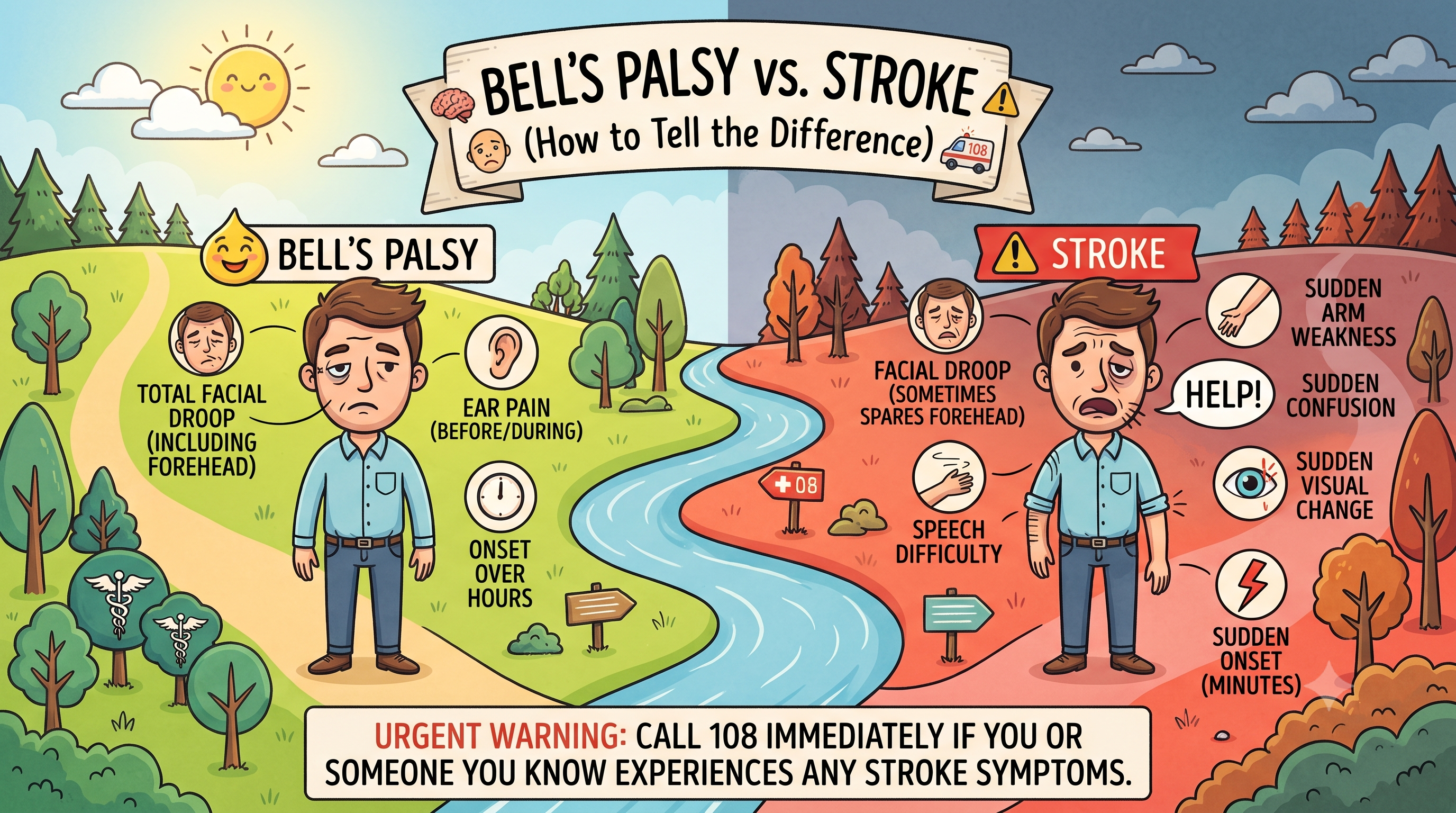
- Bell's Palsy: Typically affects the entire half of the face, including the forehead. A person with Bell's Palsy will usually be unable to raise their eyebrow or wrinkle their forehead on the affected side. They may also have trouble fully closing their eye.
- Stroke: Usually affects only the lower half of the face. The forehead is typically spared because the muscles of the upper face receive nerve signals from both sides of the brain. A stroke patient can usually still raise both eyebrows and wrinkle their forehead symmetrically.
2. Other Body Symptoms
- Bell's Palsy: The weakness is strictly limited to the face. You will not have weakness in your arms or legs. You might experience a change in taste, sensitivity to loud sounds, or pain around the jaw or behind the ear on the affected side.
- Stroke: The symptoms usually extend beyond the face. A stroke is often accompanied by the F.A.S.T. warning signs:
- Arm or leg weakness, numbness, or paralysis on one side of the body.
- Speech difficulty (slurred speech, inability to find words, or confusion).
- Vision changes (double vision or loss of vision in one eye).
- Severe imbalance, dizziness, or a sudden, severe headache.
When to Seek Medical Attention
Never try to diagnose yourself at home. If you or a loved one experience sudden facial drooping, you must treat it as a medical emergency. Call emergency services or go to the nearest hospital immediately. Only a medical professional can definitively distinguish between a stroke and Bell's Palsy through clinical examination and, if necessary, brain imaging (like an MRI or CT scan).
If it is a stroke, "Time is Brain." Getting treatment within the first few hours (the golden hour) is critical to receiving clot-busting medications or mechanical thrombectomy, which can save your life and prevent severe disability.
Treatment Approaches
The treatments for these two conditions are vastly different:
- For Bell's Palsy: Treatment usually involves oral corticosteroids (like prednisone) to reduce nerve inflammation, and sometimes antiviral medications. Eye care is also critical; since the eye may not close properly, lubricating eye drops and taping the eye shut at night are needed to prevent corneal damage.
- For Stroke: Treatment depends on the type (ischemic or hemorrhagic). It may involve emergency IV medications to dissolve clots (tPA), endovascular procedures, or surgery to control bleeding. Stroke recovery also requires extensive physical, occupational, and speech therapy.
Conclusion
While Bell's Palsy and a stroke can look remarkably similar to the untrained eye, their causes, severity, and treatments are entirely different. Bell's Palsy is a temporary nerve inflammation, whereas a stroke is a life-threatening brain injury. Always err on the side of caution—if you notice facial drooping, seek emergency neurological evaluation immediately.